From Situationship to Relationship: Steering Giving and Engagement Towards Shared Value
- by: Rivkah Block, PhD |
December 18, 2025 - Categories:
Every year, patient advocacy teams across pharma and biotech dedicate enormous energy to supporting organizations across the disease landscape. Lately, many teams have been asking a powerful question:
How do we make sure all this effort delivers the greatest possible benefit to patients?
It’s an exciting question because it doesn’t indicate misalignment, but a field that’s evolving. The intent behind engagement has never been stronger, and now is the moment to ensure we stick the landing with clarity and purpose.
We can do this by emphasizing a shared value approach in giving and engagement.
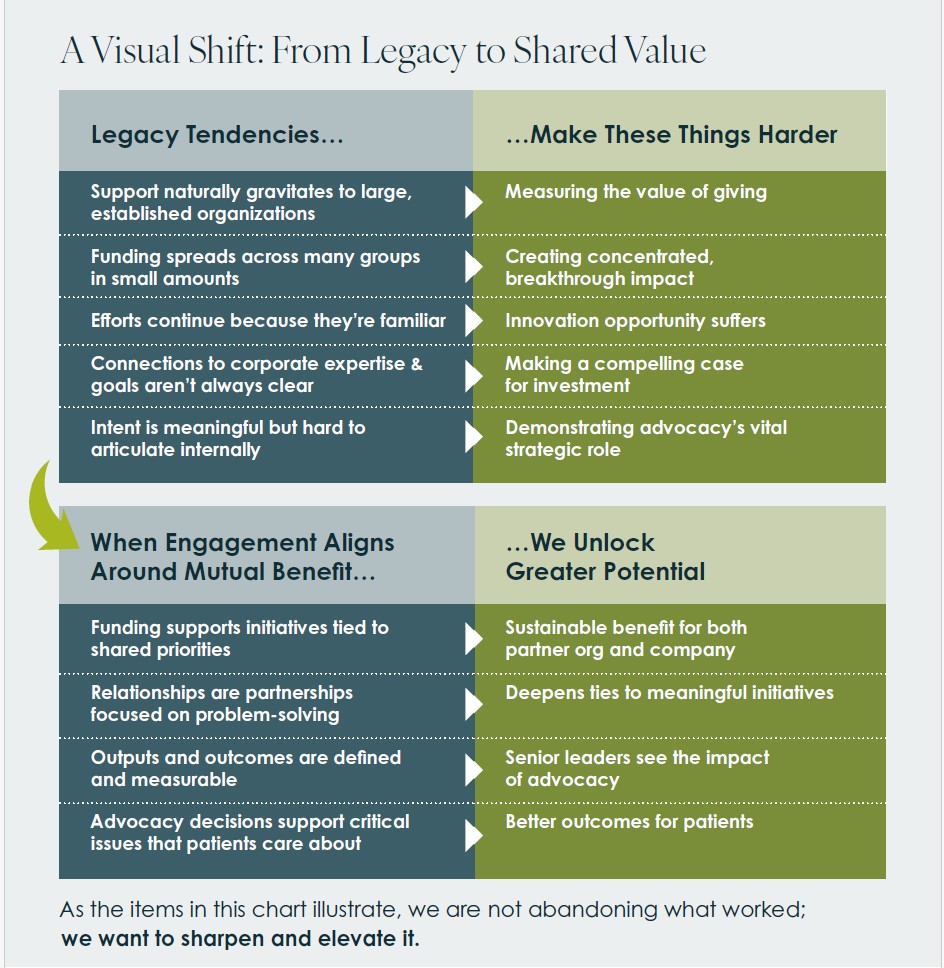
Legacy approaches aren’t “wrong”: they were simply built for a different time. Today’s environment is pushing advocacy work into new territory where teams are navigating more complex science, more dynamic patient communities, and more expectations for transparency and partnership. With this evolution comes a natural opportunity to fine-tune how we design, direct, and understand the impact of engagement.
Why This Matters Now
Mutual-benefit engagement reframes the central question from “What can we fund?” to “What can we accomplish together?” It transforms advocacy from a series of contributions into a strategic engine for insight, alignment, and patient-focused progress.
Patients and patient communities, for example, are increasingly sophisticated, and regulatory environments continue to emphasize the patient voice as an input vital to decision-making. This means that patients want (and need) to understand exactly how increasingly novel and innovative therapies work, which requires clear communication of often complex facts to patients. And how do developers communicate better with patients? By engaging in a sustained dialogue with them.
In this context, a shared-value lens doesn’t constrain engagement: it amplifies it. It ensures that time, funding, and relationships are moving the needle for everyone involved.
Being Strategic About Mutual-Benefit Engagement
Three elements consistently distinguish teams excelling in this space:
1. Mapping With Purpose
Successful teams begin with a clear-eyed view of the landscape. What are the patient priorities and unmet needs? What is the state of community readiness? What systemic dynamics shape this specific disease? This is momentum-building intelligence that helps teams sharpen focus without compromising generosity.
2. Designing Partnerships, Not Transactions
Shared-value engagement thrives when advocacy teams and patient organizations work side-by-side from the jump, enabling joint identification of issues and collaborative solutions.
3. Measuring What Matters & Making It Visible
In a mutual-benefit model, measurement moves from scoring activities to understanding progress through indicators that reflect real change. Effective measurement of important factors both strengthens internal support and helps partners see the fruits of the partnership.
Steering advocacy toward shared value creates new possibilities for what advocacy can achieve. With a focus on mutual benefit, advocacy can become a strategic catalyst, building the kind of partnerships that move the needle for both patients and the companies that serve them — the kind of partnerships that turn situationships into relationships.
To connect with Rx4good and discuss how you can move towards mutual-benefit advocacy engagement, email Chris Schultz at chris.schultz@rx4good.com.
