An ASCO Prep Roundtable, Complete with Rx4good’s ASCO Superpowers
- by: Rx4good |
March 17, 2026 - Categories:
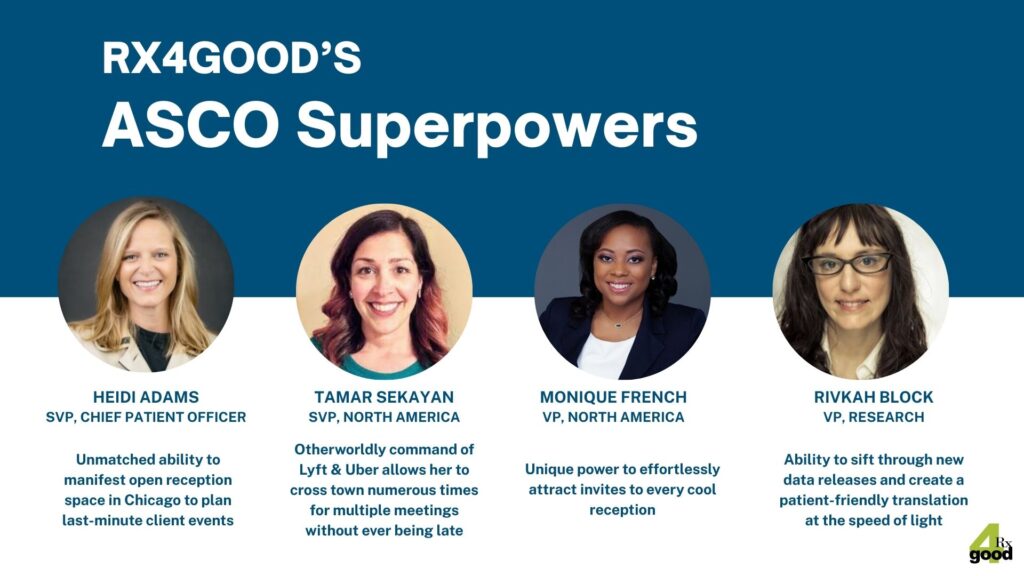
ASCO is a marathon that demands preparation. We all understand this. The question is how best to prepare.
With this question in mind, before the abstracts drop and the meetings begin, we brought together leaders from across Rx4good for an internal roundtable to speak to priorities and preparedness through three lenses:
Patient Advocacy | Strategy & Innovation | Patient Engagement
When you put these lenses in the same room, insights emerge regarding what companies should be preparing for long before they step onto the convention floor.
1. What does “ASCO readiness” actually mean?
[HEIDI] Patient advocacy groups come to ASCO with expectations of engaging in a number of ways: with HCPs to share their resources and services, with pharma partners to discuss priorities and collaboration opportunities, with fellow advocates for support and information sharing, and with new information and data to take back to their communities. Pharma advocacy teams should prepare to engage with advocacy partners across any of these dimensions; e.g., providing introductions, connections, collaboration ideas, and access to scientific expertise.
In practical terms, readiness for meetings with individual groups means that the right people from your cross-functional teams are booked for each meeting, background information has been shared with them ahead of time, meeting goals are clear for all attendees, and there is enough open space on the agenda for groups to bring forth their own priorities and concerns, ensuring two-way dialogue.
[RIVKAH] Companies should pressure-test data they are sharing before it goes public: there are many places to share, and it’s important to be thoughtful and strategic about what to share and where and how.
It’s also useful to test the language used in the data presentation. While the target audience may be HCPs, there are patients and advocacy groups present, too: run your language and framing by council members and advocacy leaders, keeping in mind who will hear it and that everyone should be comfortable with the language in your presentations.
Consider the timing of ASCO and data being released in the larger context of a company’s own work AND what’s going on for the community. Imagine another company’s trial was just abruptly closed: the community is reeling. You would probably frame your readout differently than if you are a market leader with a treatment in a disease that’s been waiting years for something promising. The community can teach us the appropriate tone given the context.
2. What are important ideas that need to be held firmly heading into ASCO?
[TAMAR] Advocacy is a dialogue, and it’s important to stay grounded in what matters. We’re all at ASCO to help raise awareness of emerging treatment options and to provide hope through data, but communication shouldn’t be one way. It’s important to use the forum as an opportunity to hear from patients and have scientists, KOLs, and community practitioners learn directly from patients about their experience and how their QOL can improve between each and every dose or treatment.
[MONIQUE] Be realistic. What seems innovative for a company could be burdensome for a patient. Ensure your engagement and approach provide value to the patient community and if the data doesn’t demonstrate that, be transparent and address it.
3. What conversations should happen before the meeting even starts?
[MONIQUE] It is proper to ensure patient advocacy groups are briefed on the agenda topics of an ASCO meeting and who from the pharmaceutical company will be representing which departments. This allows the patient advocacy group to prepare for the meeting and ensure the correct stakeholders are in the meeting.
[RIVKAH] Some companies are better than others in seeking to understand access issues and the way to address them. In the best cases, this information comes from patients and providers – not the actual docs but likely nurses who are familiar with access issues for similar treatments – and includes both what might make it difficult or impossible to get the treatment and also what might actually be helpful. Coming into a readout at ASCO with this information and sharing that your support of access issues is informed by patients is a gold star!
4. How do you ensure data doesn’t outpace patient understanding?
[HEIDI] Over-communicating is hard to do. Under-communicating, on the other hand, can lead to confusion among the patient community at best, and misinformation or suspicion at worst. Have scientific leadership lined up to respond quickly to data questions and concerns from advocates and, beyond the release, continue exploring opportunities with partners to communicate about results more broadly: webinars with the community, calls with helpline staff, shareable lay summaries. In addition, have a process in place to share back community concerns and questions with internal teams in a timely fashion so they can be appropriately addressed.
[RIVKAH] Patient community education needs to be ongoing, not just when results come out. Trial literacy is key and everyone needs to know what trials are and are not, what results mean and don’t. For each treatment, before the trial is launched, patients need to be brought in both to provide input on the study and to teach the company about access needs and how to support the larger community in understanding access support and limitations.
Companies need to be transparent with communities about what they can and cannot do for patients, explaining, for example, the reasons that everyone cannot just take a drug forever. This kind of transparency is good for companies and the community. When limitations aren’t discussed, it leads to confusion and sometimes unhappiness in a community that can come to think that companies don’t understand them, and companies risk harm to their reputations.
5. If you could give one piece of advice to emerging biotechs attending ASCO for the first time…
[MONIQUE] Hydrate and listen.
[HEIDI] Comfortable shoes!
[RIVKAH] Talk to patients before you go and to advocacy groups while you are there. Listen more than you talk.
[TAMAR] Carve in social time. Connect with people. That’s where real progress happens!
- Whether you are preparing for ASCO or otherwise navigating Patient Advocacy, Strategy & Innovation, or Patient Engagement, we’d love to talk with you. Email us: chris.schultz@rx4good.com
- Explore Rx4good’s capabilities
